

China Telescopic Mast: A Comprehensive Guide to Types, Features, and Applications
2026-11-03
When a mobile communication trailer needs to raise an antenna 30 meters in under two minutes, the telescopic mast doing the heavy lifting is rarely given a second thought. Yet in China, a quiet hub of mast manufacturing, the variety of designs—from lightweight aluminum push-up poles to heavy-duty pneumatic and electric systems—has grown so fast that even seasoned buyers struggle to compare types and specs. This guide cuts through the noise, breaking down the key categories, must-know features, and real-world applications that separate reliable masts from costly mistakes. Along the way, we’ll highlight how manufacturers like Homall Industry Limited are shaping the market with engineering that prioritizes stability, wind resistance, and ease of deployment. Whether you’re outfitting a broadcast van, a surveillance trailer, or a military command post, understanding these fundamentals will save you time, money, and field headaches.
What Makes Chinese Telescopic Masts Different from Other Suppliers?
Price is the obvious entry point, but it rarely explains why a growing number of defense integrators and broadcast equipment buyers keep returning to Chinese telescopic mast builders. The real difference often shows up in the production floor layout: many of these plants handle extrusion, machining, surface treatment, and final assembly under one roof. That vertical control lets engineers shorten the feedback loop between a requested geometry change and a revised sample, sometimes in days rather than weeks.
Beyond standard catalog items, Chinese suppliers tend to treat custom requests as normal workflow instead of expensive specials. Whether it is a non-standard collapsed height, an unusual mounting collar, or a specific locking mechanism for a vehicle roof, the engineering teams are used to modifying tooling and rewinding carbon fiber layup patterns on short notice. This comes from working with a wide range of export clients who rarely agree on a single specification, which pushes the factories to maintain flexible jigs and a deep inventory of raw tube sizes.
The third differentiator is less visible but carries more weight in field use: internal testing discipline. Many established Chinese mast manufacturers now operate their own vibration tables, salt spray chambers, and load deflection rigs, and they are comfortable sharing test reports with serial numbers tied to each production batch. That level of documentation used to be rare outside Western suppliers, but it has become a quiet standard among the top-tier Chinese workshops, making it easier to qualify them for projects where failure is not an option.
The Main Telescopic Mast Types You'll Encounter in China
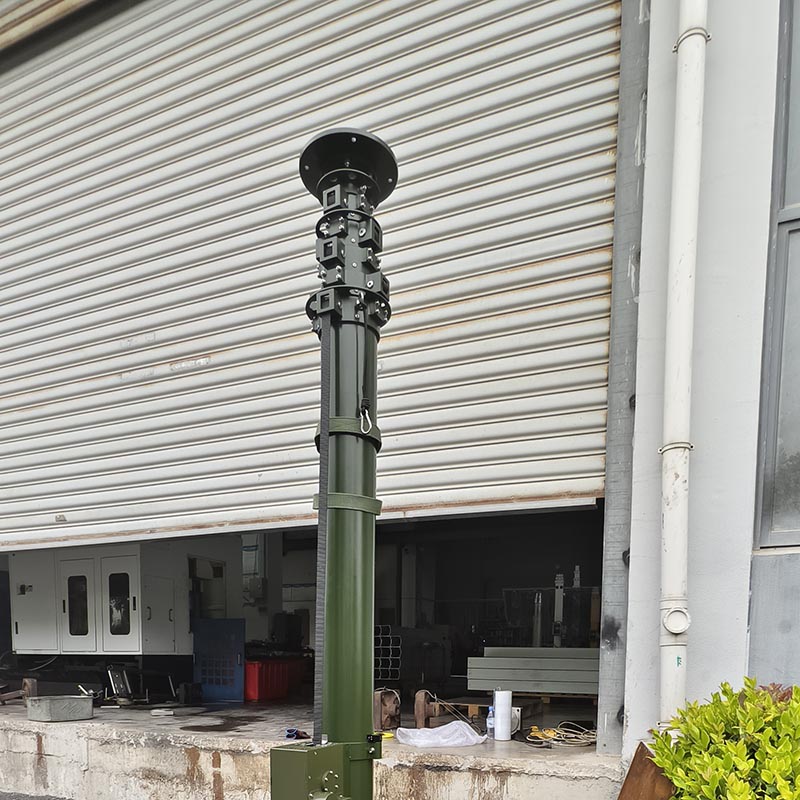
Walk into any depot or worksite across China and you'll quickly notice that telescopic masts aren't a one-size-fits-all affair. The most common type you'll bump into is the square or rectangular profile mast, built from interlocking steel or aluminum sections that slide past each other with the help of internal guide rollers. These are the workhorses of mobile lighting towers and temporary surveillance setups, valued for their low cost and straightforward maintenance. What surprises many first-time buyers is how much variation hides behind that simple exterior—wall thickness, section overlap, and locking mechanism all change depending on whether the mast needs to survive a coastal typhoon or just a dusty northern plain.
Then there are the round-tube telescopic masts, often seen in camera and communication trailers, where a smooth, continuous outer surface matters more than maximum stiffness. Chinese manufacturers have gotten particularly good at producing these with tightly controlled tolerances, using drawn aluminum or thin-wall steel tubes. Because round masts distribute wind load more evenly, they're a favorite for portable radar and emergency broadcast vehicles. You'll also come across hybrid designs—square outer sections for ruggedness paired with round inner sections for smoother extension—especially in mid-size utility trucks. Asking about the locking system early on will save you a lot of field frustration: some use spring-loaded pins, others friction locks, and the better ones now feature a locking collar that engages at every extension point.
Finally, don't overlook the heavy-duty lattice-style telescopic masts found on large lighting rigs and temporary cell towers. While technically telescopic in the way they extend, these use a lattice or truss section instead of solid tubes, gaining enormous height without the weight penalty. In China they're most common in mining operations and large-scale event staging. If you're sourcing from a manufacturer, ask about the difference between manual winch, hand pump, and pneumatic extension—each changes how quickly a crew can deploy the mast and how much maintenance it will need down the line.
Load Capacity, Locking Mechanisms, and Material Choices Explained
A tool chest isn't just a box—it's a daily workhorse that needs to hold up under real-world strain. Load capacity varies far more than most people expect: a lightweight home chest might handle 200 pounds of wrenches and sockets without complaint, while a heavy-duty rolling cabinet is engineered for 1,500 pounds or more spread across its drawers. The key isn't just the total weight, but how it's distributed. Narrow drawers with full-extension slides can safely carry fifty pounds each, while deeper bottom drawers meant for power tools need reinforced bases and double-walled construction. Look for spec sheets that list per-drawer ratings, not just overall capacity, because a single overloaded drawer can deform slides and ruin the entire user experience.
Locking mechanisms often get treated as an afterthought until a drawer slides open on a sloped driveway. The most reliable setups go beyond a single central key lock—they use tubular cam locks with anti-pry collars paired with an internal linkage that secures every drawer simultaneously. Detent-based soft-close slides prevent drawers from slamming even when unlocked, while some systems add a manual locking bar that drops into place when you push the top lid shut. If you're moving the chest between job sites, consider a mechanism that locks the casters as well, because a rolling cabinet with locked drawers but free-spinning wheels is still a hazard. Test the feel: a good lock should engage with a firm, snappy rotation rather than a mushy turn.
Material choices hinge on how much you're willing to trade weight for durability. Thin 20-gauge steel is fine for a home garage where the chest rarely moves, but it dents easily and the drawers flex under load. Step up to 14- or 16-gauge steel and you get a noticeably sturdier frame that resists racking when fully loaded. Aluminum chests cut the weight by a third but often sacrifice rigidity unless they use thick extruded frames. Watch for mixed-material tricks: some manufacturers use a steel frame with aluminum drawer fronts to save weight where it matters least. Powder-coat finishes aren't equal either—look for a multi-stage phosphate pretreatment under the paint, because bare steel that hasn't been properly etched will rust at the first scratch, no matter how thick the coating looks.
Where These Masts Show Up: From Military to Media
On forward operating bases, telescoping masts lift antennas high enough to clear ridgelines and concrete barriers, turning patchy handheld radio signals into reliable squad-level comms. The same hardware carries pan-tilt cameras and radar arrays that watch convoy routes or airspace, often running on silent, hand-cranked elevation to avoid generator noise. Field engineers value how quickly a single soldier can lock a mast into place and run a cable back to a sheltered radio stack.
Broadcast news crews rely on a lighter, faster version of the same idea: a pneumatic mast strapped to a live truck that pushes a microwave link or cellular bonded transmitter above tree lines and building clutter. In crowded downtowns or stadium parking lots, that extra fifteen meters makes the difference between a stable live shot and a frozen frame. Radio stations, too, still mount FM antennas on freestanding lattice masts at shared transmitter sites, though most viewers never notice the quiet steel towers behind their evening news.
Between those extremes sit a whole range of temporary deployments: wildfire incident command posts hoisting weather sensors and mesh networking nodes, coastal rescue teams raising AIS receivers to track vessels beyond the horizon, and event organizers lifting temporary cell boosters for festivals in remote canyons. Each use borrows from the military’s ruggedized clamps and the media’s rapid-deploy mindset, proving that a simple vertical pole remains one of the most adaptable tools for line-of-sight problems.
How to Choose the Right Chinese Mast for Your Project
Before you settle on a Chinese mast supplier, pin down the real load case instead of relying on the catalog's maximum capacity. Many project delays trace back to underestimating eccentric loads from offset antennas or cameras, wind gusts on uneven terrain, and the fatigue effect of constant vibration. Ask for a detailed structural calculation under your specific site conditions, and if the supplier can't provide one signed by a licensed engineer, walk away.
Match the mast's surface treatment to the environment, not just the price tag. A hot-dip galvanized mast with less than 85 microns of coating may look fine in a warehouse but will rust within two years near a coast or chemical plant. For installations within 5 kilometers of saltwater, request a duplex coating or specify a higher-grade steel like Q355NH. Also check the thickness consistency at welds—corrosion always starts where the zinc is thinnest.
Dig into the factory's own quality control rather than the sales pitch. A reputable Chinese mast maker will share photos or video of weld inspection, material test certificates for each batch, and a load test report for your exact configuration. If you can, order one extra mast section and cut it open; the internal weld penetration and galvanization on hidden surfaces tell you more than any brochure.
Keeping Your Telescopic Mast Operational for Years
A telescopic mast can easily become a forgotten piece of gear until the day it refuses to extend. Make a habit of wiping down each section after use, especially if it has been near salt spray or dusty ground. Even a thin layer of grit left between the sliding surfaces will accelerate wear and lead to sticky or uneven operation.
Lubrication matters, but more is not always better. Use a dry silicone spray or a light machine oil recommended by the manufacturer, applying it sparingly to the locking collars and guide surfaces. Avoid heavy grease, which traps dirt and turns into a grinding paste over time. If the mast starts feeling rough, stop and clean the affected section rather than forcing it through the motion.
Beyond regular cleaning and lubrication, pay attention to how the mast is stored and transported. Keep it fully collapsed and, where possible, store it vertically or in a padded case to prevent small dents or bends. Check locking mechanisms every few months, and replace any worn collars or cracked sections before a minor fault turns into a complete failure in the field.
FAQ
Chinese manufacturers typically offer manual push-up, electric, pneumatic, and hydraulic masts, with round, square, or triangular cross-sections in aluminum, steel, or carbon fiber. Each type suits different loads, speeds, and environments.
They generally deliver strong value, often undercutting Western counterparts by 30-50% while meeting ISO or MIL-STD requirements if you choose certified factories. Quality varies widely, so audits and sample testing matter more than the brand name.
You'll see them on communication trailers, surveillance vehicles, portable lighting towers, weather stations, emergency response units, and military field deployments. They're also used for temporary antennas, cameras, and sensors in remote or mobile setups.
Standard models span roughly 3 to 30 meters, with custom builds reaching 40 meters or more. The practical limit depends on payload weight, wind speed, and whether the mast is guyed or freestanding.
Focus on rated load capacity at full extension, locking mechanism safety, corrosion-resistant finishes, wind survival ratings, ease of deployment, and mounting compatibility. Overlooking any of these leads to field failures.
Wipe down sections after use to remove grit, lubricate sliding surfaces with a dry or silicone-based lube, inspect cables and seals for wear, and store in a dry, vertical position. Always retract fully before transport to prevent damage.
Yes, most Chinese manufacturers accept custom orders for length, color, mounting plates, control interfaces, and even integration with cameras or antennas. Expect longer lead times for nonstandard designs.
Under-specifying wind or payload requirements, skipping factory audits, ignoring return policies, and underestimating freight costs are the biggest mistakes. Always get written load charts and test reports before ordering.
Conclusion
Chinese telescopic masts differ from other suppliers primarily because of vertical integration: aluminum extrusion, CNC machining, anodizing, and assembly often happen within the same industrial cluster, leading to shorter lead times, lower minimum order quantities, and easier custom geometry. Among the main types you'll encounter, push-up masts with friction locks are the cheapest for lightweight loads, pneumatic masts use compressed air for rapid deployment in vehicles, and electric or crank-up masts provide finer height control with positive locking pins for heavier payloads. Load capacity is not solely about vertical dead weight; the locking mechanism's resistance to torque and side-load vibration matters more in mobile applications. Material choices typically include 6061-T6 aluminum for general use, carbon fiber for satellite uplink or camera stabilization, and 316 stainless steel for marine or chemical exposure.
Applications span military communication shelters, border surveillance towers, broadcast news vans, and temporary camera masts for sports and concerts. Choosing the right Chinese mast means matching maximum extended height, retracted transport length, payload at full extension, and deployment time—many buyers overlook the fact that a pneumatic mast requires an air compressor, while a manual crank mast demands physical effort at height. To keep the mast operational for years, clean the nested tubes after sandy or salty use, replace rubber O-rings and wiper seals every two to three years, and never use petroleum-based grease on aluminum sliding surfaces because it traps grit; a dry PTFE lubricant or silicone spray works better. Check anodized coatings for scratches that expose raw aluminum and lead to galvanic corrosion.
Contact Us
Contact Person: Ryan
Email: [email protected]
Tel/WhatsApp: +85259582726
Website: https://www.robomast.com/