

Cleanroom HVAC System Factory: Key Factors for Reliable Air Quality Control
2026-08-27
When a single airborne particle can compromise an entire sterile batch, the cleanroom HVAC system becomes more than infrastructure—it becomes your first line of defense. But not all factories build these systems the same way. From filter integrity to pressure cascade design, the details often decide between compliant production and costly downtime. At GENO Pharmatech, we’ve seen how the right engineering choices transform air quality from a recurring headache into a silent, reliable partner. Here’s what actually matters when selecting a cleanroom HVAC factory for pharmaceutical-grade environments.
Why Temperature and Humidity Fluctuations Undermine Cleanroom Stability
Even a shift of two or three degrees Celsius changes air density enough to disturb the carefully balanced pressure cascades that keep particles moving away from critical zones. In a unidirectional airflow cleanroom, warmer air rises and creates micro-turbulence near work surfaces, which can pull contaminants from operator gowns or equipment housings into the sterile field. The result is not always visible, but settle plates and particle counters often tell the story within hours.
Humidity swings are just as disruptive, though they work through different mechanisms. Low relative humidity increases surface charge, causing particles to cling to gloves, packaging, and walls instead of being swept away by HEPA-filtered air. High humidity, on the other hand, creates condensation risks on cold surfaces and encourages microbial growth in corners and behind equipment. Both extremes force the HVAC system to work harder, leading to wider control swings and a cycle that is difficult to break.
Over time, these fluctuations degrade not just cleanliness but also process repeatability. Instruments drift, static-sensitive components behave unpredictably, and operators may adjust their movements or change gowning habits to compensate. Once an environment loses its steady baseline, every subsequent correction becomes reactive rather than preventive, and that quietly erodes the cleanroom's core purpose.
The Filtration Hierarchy That Keeps Particles Out
The outermost layer has one job—grab the biggest stuff before it can bury the finer stages downstream. Fibers, dust clumps, visible specks, even hair all collide with a nonwoven mat whose irregular pore paths force the flow to zigzag. That sudden change in direction throws heavier particles off course, letting them lodge in the first few millimeters. As air or liquid moves inward, the next layers tighten their focus. Medium-density media intercept pollen, mold spores, and fine industrial particulates through a blend of sieving and depth loading. The innermost stage, often a dense membrane or charged fiber web, turns to diffusion and electrostatic attraction to snare submicron particles that move erratically or carry an opposite charge. No single layer tries to do everything, which keeps the whole system from choking too soon.
The real advantage shows up in how the layers share the workload. A coarse prefilter takes the brunt of large-particle loading, which means the expensive high-efficiency media behind it lasts far longer. The middle layer catches what the prefilter can't, and the final stage clears out the stubborn fraction under 0.3 microns—the size range that slips through many single-stage filters. Engineers adjust the spacing, density, and charge of each stage depending on whether the goal is protecting a motor, maintaining a cleanroom, or keeping drinking water clear. The result isn't one solid wall but a coordinated series of checkpoints. Any particle that wants to reach the clean side has to survive several increasingly strict passes, and very few do.
Airflow Patterns That Prevent Cross-Contamination
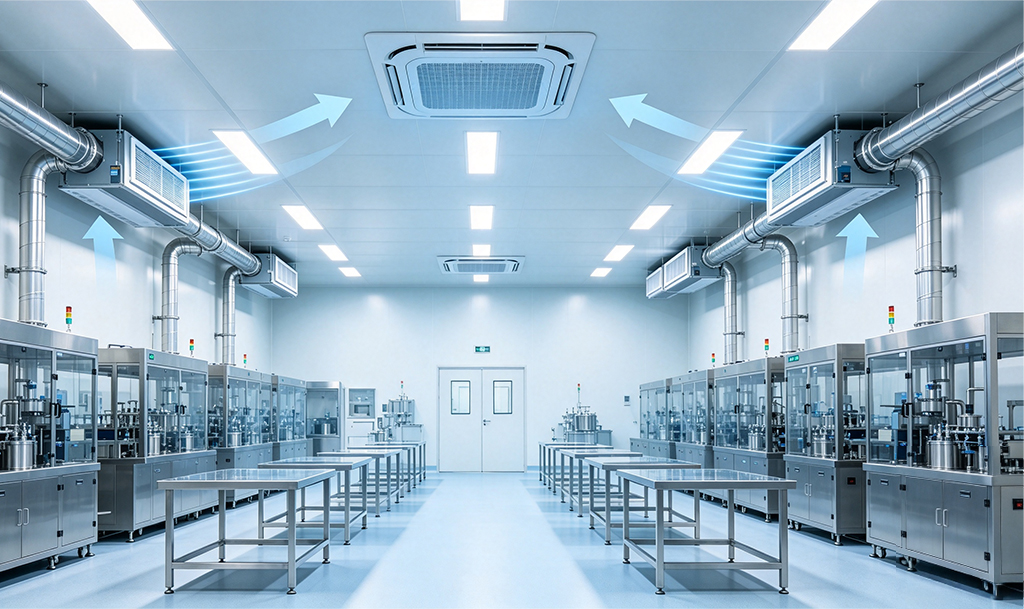
Most cross-contamination events don’t begin with a visible spill or a torn glove. They start with a subtle shift in how air moves across a workspace. Unidirectional airflow—often called laminar flow—keeps particles moving in a single direction and away from sensitive materials. When that pattern breaks, even for a few seconds, airborne contaminants can loop back into a clean zone, carried by micro-eddies that are nearly impossible to see.
Pressure differentials do much of the heavy lifting behind the scenes. A cleanroom or isolator that maintains higher pressure than the surrounding hallway pushes air outward through gaps and door seals. That outward flow acts as a barrier, so particles from a less controlled area can’t drift inside. The trick is to pair this with return-air grilles placed low and opposite the supply, which gives particles a predictable path to exit rather than recirculating past the product.
Air change rates matter, but they aren’t a standalone fix. Too few changes per hour allows contaminants to linger; too many can create turbulence that defeats the purpose. The best layouts position supply diffusers so they sweep across a workspace without bouncing off equipment, and they avoid dead zones behind large instruments where air stagnates. Regular smoke studies reveal these flaws quickly—showing exactly where the airflow bends, stalls, or reverses before it becomes a contamination problem.
Pressure Cascades: The Invisible Barrier
A pressure cascade doesn't announce itself with a visible wall or a sudden stop. It builds through a series of small, linked drops in pressure that quietly reshape how air, water, or even workload moves through a system. By the time the effect reaches a critical point, the original cause is often buried under layers of secondary responses.
What makes this barrier so stubborn is that it feeds on momentum. Each local pressure change triggers a compensating shift, which then alters the conditions for the next stage. The result is a self-reinforcing pattern that resists simple fixes. Adding more force upstream often just intensifies the cascade, creating a bottleneck that appears to have no single source.
Breaking through requires looking at the sequence as a whole rather than attacking the most obvious symptom. Once you map the pressure drops and their feedback loops, the invisible barrier starts to reveal its shape. The solution rarely lies in overpowering it; it lies in interrupting the cascade early enough that the barrier never fully forms.
Continuous Monitoring: Catching Drift Before It Becomes a Problem
Most drift doesn't announce itself with a sudden accuracy drop. It accumulates in the quiet corners of your feature distributions—transaction amounts creeping upward, user demographics shifting across regions, or the language in support tickets changing after a product update. When these small movements go unnoticed, the model keeps making decisions based on assumptions that no longer hold. Continuous monitoring turns those invisible shifts into visible signals, so you can respond while retraining is still a choice rather than a crisis.
Effective monitoring means watching more than just the output score. You need to track input distributions, prediction confidence, missing value rates, and even the relationship between features and labels over time. A single aggregate metric can hide localized drift in a high-value segment. For example, an overall fraud model might look stable while silently losing precision on new payment methods. Breaking down your monitoring by key cohorts or regions exposes these weak spots before they affect real decisions.
The goal isn't to chase every statistical fluctuation—that leads to alert fatigue and unnecessary retraining. Instead, pair automated checks with clear thresholds and a lightweight review process. When drift crosses a boundary, investigate whether the change is expected, like a seasonal pattern, or whether it signals a deeper shift in user behavior. This balance keeps your team focused on meaningful problems and ensures small drifts are handled early, not after they've already become costly failures.
Maintenance Habits That Extend HVAC Lifespan and Performance
Most HVAC systems don't fail overnight—they fade because small things get ignored. A habit as simple as checking the condensate drain line every month can stop water damage and mold before they start. Pour a cup of white vinegar down the line, wait thirty minutes, then flush it with warm water. That tiny routine costs less than a dollar and prevents one of the most common reasons for emergency service calls.
Your air filter tells you more than you think. Instead of waiting for a reminder, hold it up to a light every two weeks during heavy-use seasons. If you can't see through it, replace it—even if the calendar says otherwise. And don't fall for the myth that thicker filters always help. A filter that's too restrictive makes your blower work harder and can shorten its life. Match the MERV rating to what your system was designed for, not what the packaging promises.
Outdoor units suffer quietly. Leaves, grass clippings, and cottonwood fluff build up on the condenser fins and choke airflow. Every month, shut off the power and use a garden hose with a gentle spray to wash the fins from the inside out. Keep at least two feet of clearance around the unit—no shrubs, fences, or stored junk. And once a season, check the fins for bending. A fin comb costs a few bucks and takes ten minutes to straighten crushed areas, restoring the heat exchange that your system depends on.
FAQ
In a cleanroom, the HVAC system isn't just about comfort—it's the primary barrier against particle contamination. Key differences include high-efficiency filtration (typically HEPA or ULPA), precisely controlled airflow patterns like laminar or unidirectional flow, and tight regulation of pressure differentials between adjacent spaces. Commercial systems rarely need to maintain ISO Class 5 cleanliness or prevent cross-contamination between rooms with different cleanliness levels.
Even minor fluctuations can disrupt processes. Too much humidity encourages microbial growth and can cause static discharge, while low humidity increases particle adhesion to surfaces. Temperature changes alter air density and can interfere with the designed airflow pattern, causing turbulence that lifts particles from floors or equipment. A robust cleanroom HVAC system keeps both within narrow bands—often ±0.5°C and ±3% RH for sensitive operations.
Pressure differentials prevent unfiltered air from migrating into cleaner areas. Higher-pressure cleanrooms push air outward through door gaps, while lower-pressure zones keep hazardous materials contained. If the cascade fails—say a door is left open or a fan speed drifts—airflow can reverse, introducing contaminants. Modern systems use active differential pressure sensors and variable-speed fans to maintain the cascade even when doors open or filters load with dust.
Air changes per hour (ACH) determine how quickly the HVAC system can dilute and remove airborne particles. Cleanrooms often require 20 to 600 ACH depending on classification—far more than an office's 2-4 ACH. Higher ACH provides faster recovery from contamination events, but it also increases energy costs. The trick is sizing the system to hit the required ACH without over-ventilating, which can dry out products or create excessive noise.
Filter leaks are a silent killer of cleanroom performance. Beyond scheduled replacements, every HEPA or ULPA filter should undergo periodic in-situ aerosol photometer testing—not just a visual check. A practical schedule might test critical filters every six months and less critical ones annually, but any pressure drop spike or particle count drift should trigger an immediate scan. Records of these tests matter more than the test itself for regulatory audits.
Recovery time depends on airflow capacity and control response. A well-tuned system uses fast-acting actuators on terminal dampers and variable-speed drives on fans to ramp airflow within seconds. Cleanrooms with unidirectional flow typically recover in under a minute; turbulent flow rooms might take several minutes. Designing for the worst-case scenario—like a pass-through door left open during material transfer—prevents routine operations from ruining a batch.
Many factories over-pressurize and over-filter because they're afraid of contamination. Instead, consider demand-controlled filtration: reducing airflow during non-production hours while keeping positive pressure. Heat recovery from exhaust air can cut reheat energy dramatically, and using EC motors on fan arrays allows precise part-load efficiency. Another rarely used tactic is separating temperature control from humidity control with a dedicated outdoor air system, avoiding simultaneous heating and cooling.
Interior surfaces should not shed particles or off-gas. Galvanized steel with a smooth, sealed coating is standard, but in aggressive chemical environments, stainless steel or epoxy-coated surfaces prevent corrosion that releases particles. Drain pans must slope completely to avoid standing water where microbes breed. Gaskets and sealants need to be low-outgassing and resistant to cleaning agents—otherwise they degrade and become contamination sources themselves.
Conclusion
Temperature and humidity swings get less attention than filter specs, but they quietly shape particle behavior and microbial survival. Even a 2°C drift or a 5% relative humidity shift can alter air density, disrupt pressure balances, and create condensation risks that compromise sterility. Practical cleanroom designs start with precise thermal and humidity control, layered over a filtration hierarchy. Coarse pre-filters grab larger debris, intermediate filters catch finer particulates, and final HEPA or ULPA banks strip sub-micron contaminants before air reaches the clean zone. Airflow design matters just as much—unidirectional or low-turbulence displacement patterns sweep particles away from critical operations instead of letting them recirculate or settle. Without that deliberate air movement, even the best filter bank cannot stop localized contamination. This integrated view of environmental stability separates dependable cleanroom operations from those that lurch from one contamination event to the next.
Pressure differentials act as an invisible barrier, pushing air from cleaner spaces toward less clean ones whenever a door opens or a breach occurs. Well-tuned cascades depend on continuous monitoring—particle counters, humidity sensors, temperature probes, and differential pressure transmitters give early warning of drift long before it becomes a product risk. A disciplined maintenance routine holds everything together: regular filter replacements, coil cleaning, fan belt inspections, and sensor calibration keep the HVAC system at designed capacity, prevent energy waste, and stretch equipment life. Factories that treat these elements as one integrated system rather than isolated fix-it tasks consistently deliver reliable air quality control under real production loads.
Contact Us
Contact Person: Amy Yang
Email: [email protected]
Tel/WhatsApp: 008619330882686
Website: https://www.genopharmatech.com/