

Curved Treadmill Training: How to Boost Performance and Burn Calories Faster
2026-05-09
Are you tired of the same old treadmill routine? Curved treadmills are revolutionizing cardio by delivering a more natural running experience that torches calories and boosts performance. Unlike conventional machines, they activate more muscles and let you control the pace with your own stride. At Yingruis, we've harnessed this innovation to help you unlock your full potential. Let's dive into how curved treadmill training can transform your workouts.
Why Your Standard Treadmill Is Secretly Slowing You Down
You might think you're clocking killer miles, but the belt beneath your feet could be subtly sabotaging your stride. Standard treadmills force you into a shorter, choppier gait because your brain is always subconsciously adjusting to the moving surface—you're bracing not to slip, not to propel forward. Over time, that unnatural shuffle becomes muscle memory, and when you hit the pavement, you find yourself covering less ground with each step. Your natural running economy takes a hit without you even realizing it.
There's also the matter of what's missing. A treadmill gives you a perfectly flat, predictable platform—no uneven trails, no cambered roads, no headwind. Outside, your body constantly recruits tiny stabilizer muscles to adapt, building that resilient, reactive strength that makes you faster. On the standard machine, those muscles clock out. You end up with a one-dimensional kind of fitness that looks good on a screen but crumbles under real-world variety.
And then there's the data illusion. The console might say you're flying at a seven-minute-mile pace, but the motor's assistance and belt whip can inflate numbers by a surprising margin. You start training off false benchmarks, aiming for splits you're not actually hitting in a real race. It's not that treadmills are useless—just that the default machine is often a wolf in sheep's clothing, draining your natural speed while convincing you everything's fine.
The Unfair Advantage of Curved Belt Training
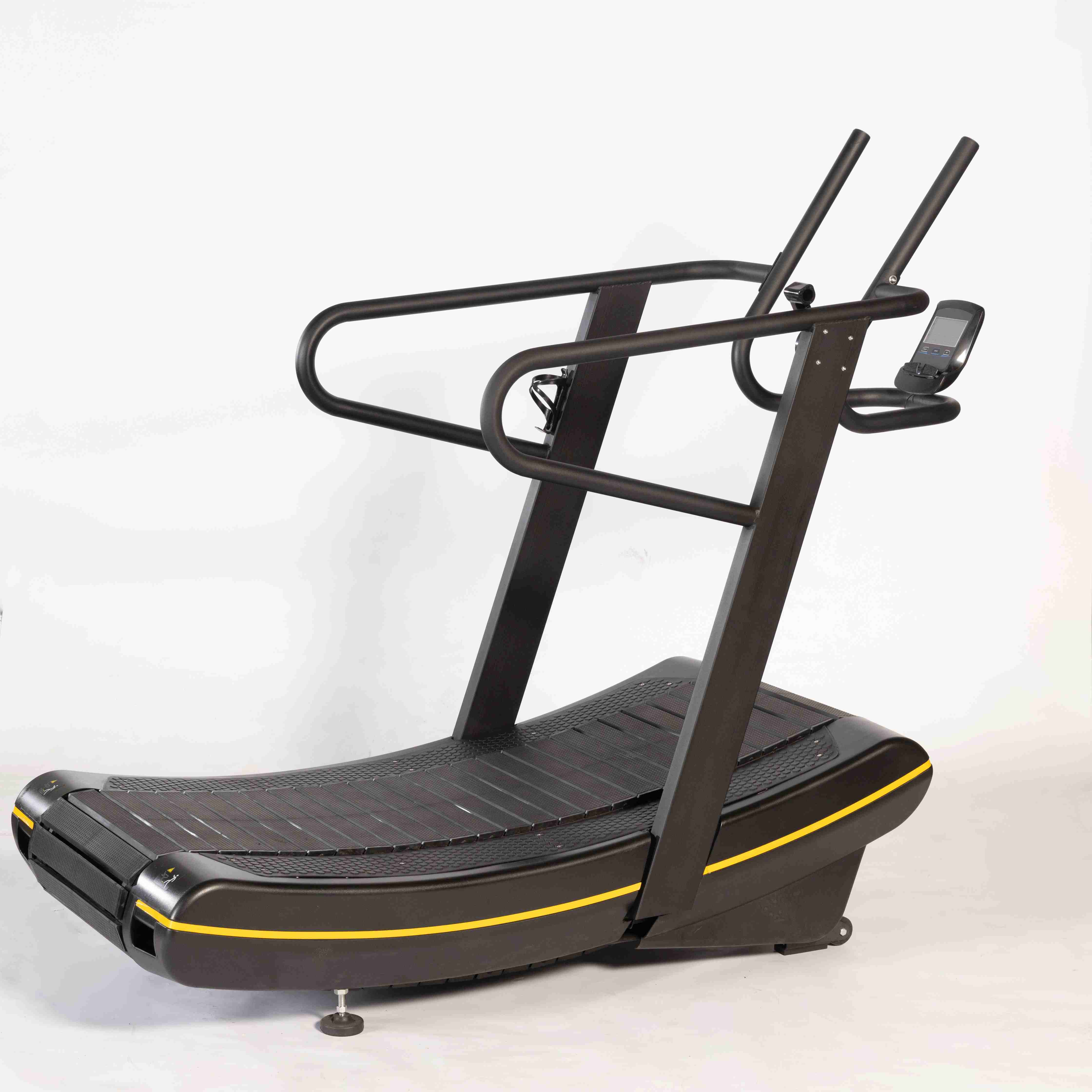
Curved belt training reshapes the way athletes build speed and endurance by eliminating the reliance on motors. Instead of following a preset pace, you dictate the movement—every stride demands propulsion, engaging the posterior chain more than traditional treadmills. This self-governing design forces a forward lean that mimics real-world sprinting mechanics, making it a superior tool for developing explosive power.
The lack of a motor doesn't just cut electricity costs. It shifts the workload entirely onto your body, transforming each session into a high-efficiency workout. Because the belt moves only when you apply force, there's no coasting—this means constant tension on the hamstrings and glutes, leading to greater muscle activation and a higher calorie burn in less time.
Perhaps the most overlooked benefit is the reduction in joint stress. The curved shape encourages a midfoot strike and a shorter, more frequent stride, which naturally lessens impact compared to pounding on a flat, motorized surface. For rehab clients or those looking to extend their training longevity, this subtle biomechanical shift is a game changer.
Burn More Calories Without Running Faster
Shifting your focus from sheer speed unlocks surprising ways to torch extra calories. Instead of hammering the pavement harder, tweak your form and posture. Engage your core, pump your arms more deliberately, and lift your knees slightly higher. These micro-adjustments recruit more muscle fibers, especially in your upper body and midsection, which quietly drain more energy without a single increase in pace. It’s about running smarter, not faster—letting inefficient-looking movements actually become your secret metabolic weapon.
Another lever is terrain and incline. Swap flat routes for rolling hills or hit a trail where uneven surfaces force your stabilizer muscles to fire constantly. The constant micro-adjustments to maintain balance on gravel or grass hike up your heart rate without asking for a sprint. Even on a treadmill, cranking the incline to 3–5% while maintaining your usual jogging speed can boost calorie burn by up to 15%. You’ll finish the session feeling like you worked harder, but your watch will show the same comfortable pace.
Don’t overlook rhythm disruption. Our bodies are masters of efficiency, so altering your stride pattern or inserting short, non-maximal stride changes every few minutes keeps the engine guessing. Try a minute of side shuffles, backwards jogging, or exaggerated high-knees mid-run. These variations break monotony and prevent metabolic adaptation, while staying entirely in the aerobic zone. It’s a playful, low-impact way to spike energy expenditure—and it makes the minutes tick by faster without adding intensity that wears you down.
Turn Every Run Into a Full-Body Workout
Running is often pigeonholed as a leg-only exercise, but with a few intentional tweaks, you can transform it into a comprehensive session that engages your core, arms, and back. The trick lies in your posture and movement patterns. By keeping your chest tall, shoulders relaxed and pulled back slightly, and actively driving your elbows behind you, you fire up your upper body muscles with every stride. Simultaneously, engaging your deep core stabilizers—think drawing your navel toward your spine—not only protects your lower back but also adds a subtle rotational challenge that works your obliques. It’s a shift that turns a simple jog into a cohesive, muscle-building rhythm.
Taking it a step further, integrating dynamic interruptions into your run can amplify the full-body payoff. Instead of plodding along at a steady pace, sprinkle in short bursts of exercises that break the monotony and activate dormant muscle groups. Stop every half mile for a set of walking lunges with a twist, or pause at a park bench for incline push-ups and tricep dips. Even a 30-second wall sit or a sprint with exaggerated arm pumps can spike your heart rate while sculpting your shoulders and glutes. These mini circuit breaks not only build functional strength but also fight the boredom that often comes with long-distance pavement pounding.
Finally, don’t underestimate the role of terrain and intensity in crafting a holistic workout. Hills, trails, and stairs force your body to adapt in ways that flat surfaces never will. Climbing a steep incline automatically recruits your calves, hamstrings, and glutes more aggressively, while navigating uneven trails demands constant micro-adjustments from your ankles, hips, and core for balance. To finish strong, cap your run with a few all-out strides, swinging your arms with controlled power, and you’ll leave feeling equally spent in your upper and lower body. The result? A run that truly leaves no muscle behind, all without stepping foot in a gym.
The Science That Makes Curved Treadmills Superior
Curved treadmills are powered entirely by the user—there's no motor. This self-propelled design engages more muscle groups, especially the posterior chain, because you must actively pull the belt back with each stride rather than simply keeping up with a moving surface. The result is a higher workload at the same perceived speed, leading to greater energy expenditure and a more efficient cardiovascular workout.
The subtle forward lean naturally adopted on a curved treadmill shifts the body’s center of mass, encouraging a more upright posture and a midfoot strike. This reduces impact forces compared to traditional flat treadmills, where the moving belt can encourage a harder heel strike. Over time, this can lower injury risk and improve running economy by strengthening the muscles that stabilize the ankles and knees.
From a biomechanical standpoint, the curve also alters the moment arm at the foot and ankle, requiring the calves and glutes to work harder during push-off. Studies have shown that oxygen consumption and heart rate are significantly higher on curved treadmills at matched speeds, making them a superior tool for high-intensity interval training and metabolic conditioning without needing to increase pace.
Master the Self-Powered Machine for Real-World Gains
Tapping into ambient energy has moved beyond experimental labs, reshaping how we power critical infrastructure. Self-powered machines draw from solar, thermal, vibration, or even radio frequency sources, eliminating the tether of batteries and wired grids. Understanding how to optimize these harvesters for specific real-world conditions—varying light levels, fluctuating temperatures, or intermittent motion—creates devices that run indefinitely with virtually no maintenance. When you stop chasing battery replacements, you unlock deployments in remote pipelines, inside building walls, or across acres of farmland, where constant human access just isn’t practical.
The real payoff comes when you scale this autonomy. In agriculture, self-powered soil sensors buried once can transmit moisture and nutrient data for a decade, slashing labor and downtime. On factory floors, vibration-harvesting nodes on rotating machinery catch early warning signs without periodic shutdowns for battery swaps. These gains aren’t theoretical—they show up as leaner operational budgets, reduced e-waste, and more granular data than ever before. The trick is matching the harvester type to the use-case energy signature, then fine-tuning the power management circuitry so the device wakes, does its job, and goes back to sleep without wasting a microwatt.
But mastery doesn’t stop at hardware. It means rethinking system architectures to thrive on erratic energy curves. Engineers who combine ultra-low-power microcontrollers, intermittent computing techniques, and robust energy buffers create machines that gracefully handle power dips. The result? Uninterrupted monitoring in places that eat batteries for breakfast—think sub-zero freezers, desert weather stations, or bridges under corrosive salt spray. When you master these designs, you move from simply saving money to enabling entirely new services like perpetual asset tracking or pollution mapping across a city, where the absence of maintenance visits directly translates into a competitive edge.
FAQ
A curved treadmill is a non-motorized machine with a concave running surface. You power it entirely with your own legs—there's no motor, so the belt only moves when you run or walk. This forces you to engage more muscles and stay mindful of your pace, unlike a motorized treadmill where the belt pulls you along.
It comes down to control and intensity. Because you're driving the belt, you naturally run with better form and a higher calorie burn. It's also great for interval training without pressing buttons—just speed up or slow down with your effort. Many athletes prefer it for sprint work and metabolic conditioning.
Yes. Studies and practical use show that the self-powered mechanism demands more from your posterior chain and core. You typically burn 30-40% more calories at the same perceived effort compared to a motorized treadmill because you eliminate the belt's assistance and work against gravity differently.
You'll see improvements in acceleration, top-end speed, and running economy. Because you can't 'zone out'—every stride affects the belt—it sharpens your foot strike and reduces ground contact time. Sprinters and team sport athletes use it to build explosive power without joint stress from hard surfaces.
It's actually lower impact when done correctly. The curved design encourages a midfoot strike and natural gait, distributing force more evenly. Beginners should start with short intervals and proper footwear, just like any new training tool. It's not inherently risky, but bad form on any treadmill can cause issues.
Try interval-based sessions: warm up with 3 minutes of easy running, then alternate 30-second hard sprints with 60 seconds of recovery for 10-15 rounds. Finish with a cooldown. The self-regulating speed makes high-intensity bursts seamless—you simply explode into the sprint and ease back when needed.
The biggest one is leaning back and 'braking' with each step, which kills momentum. Keep a slight forward lean from the ankles, pump your arms, and land under your hips. Another error is starting too fast before mastering the rhythm—give yourself time to find the belt's sweet spot.
Absolutely. It's for anyone wanting a challenging, efficient workout. Walkers can benefit from increased glute and hamstring activation at slower speeds. It's also used in rehab settings because the movement is more natural and loads the joints less than hard pavement. Just lower the intensity and duration to match your fitness level.
Conclusion
Many runners never realize that a traditional motorized treadmill does much of the work for them. The belt pulls your foot backward on each stride, reducing the need to engage your posterior chain and core. Over time, this can weaken natural running mechanics and even set you up for overuse injuries. Curved treadmill training strips away that artificial assistance. Because the belt is self-powered and contoured, every step you take propels the deck forward—you generate all the movement yourself. This shift forces you to drive actively through your glutes and hamstrings, mimicking outdoor acceleration with each stride. Research confirms that curved designs demand significantly higher heart rates and oxygen consumption at the same perceived speed, meaning you reap more cardiovascular and muscular benefits in less time.
That heightened demand translates directly into greater calorie burn. Even at a casual jogging pace, the lack of motor support makes your body work harder, so you don’t have to sprint to torch extra calories. Beyond pure energy expenditure, the curved belt naturally engages your core and arms to maintain balance, turning a straightforward run into a coordinated full-body effort. To make the most of this tool, shift your focus from speed to form. Short, powerful bursts where you actively drive the belt teach you to recruit more muscle fibers, building the kind of endurance that carries over to road and trail running. Gradually, you’ll notice faster recovery between intervals and a more resilient stride. By mastering this self-propelled machine, you turn every session into a functional training opportunity—one that sharpens your running economy, strengthens underused stabilizers, and ultimately boosts real-world performance without artificial gimmicks.
Contact Us
Contact Person: Owen Wu
Email: [email protected]
Tel/WhatsApp: 86-15376736259
Website: https://www.yingruisfit.com/