

Custom 2 Ply Engraving Plastic Manufacturer for Durable, High-Precision Signage Solutions
2026-11-16
When durability meets precision, signage becomes more than just a label—it becomes a statement. For businesses that demand crisp, long-lasting identification, the choice of material and manufacturing partner matters. At LYSHIRE, we’ve redefined what custom 2-ply engraving plastic can do, combining robust construction with high-definition detail that stands up to harsh environments without fading or delaminating. But what really sets a premium engraving plastic apart from the rest? And how can the right manufacturer turn a simple sign into a flawless branding tool? Before you place your next order, there are a few hidden truths about 2-ply engraving that could change the way you think about signage forever.
Layering Strength Into Every Sign
Our fabrication process doesn't just weld metal—it fuses resilience. Every cut, bend, and joint is engineered to withstand years of weather, vibration, and daily wear without losing its crisp finish. That means you get signage that stands tall in a storm, not something that rattles loose after one season.
We laminate internal bracing systems directly into the sign's core, turning a flat panel into a structural shell. This hidden backbone distributes weight and impact evenly, preventing warping and keeping corners sharp long after installation. It's the kind of quiet reinforcement you’ll never see, but will feel every time the sign holds steady in high winds.
Beyond metals and frames, we integrate strength into the surface itself. UV-cured coatings shield against fading, while micro-textured layers repel moisture and graffiti. The result isn't just a durable sign—it's a visual asset that refuses to fade, peel, or buckle, regardless of what the elements throw at it.
Where Precision Meets Plastic Durability
In a world where manufacturing tolerances are measured in microns and material resilience determines product lifespan, the intersection of meticulous engineering and advanced polymer science becomes a quiet but powerful differentiator. It’s not merely about molding plastic into shape—it’s about orchestrating a process where every cooling channel, fill rate, and pressure curve is dialed in so that the final component mirrors the digital model with near-religious fidelity.
This convergence demands more than high-end machinery. It requires a mindset that treats polypropylene, nylon, or polycarbonate not as generic stock, but as living materials with distinct personalities—each with its own flow behavior, shrinkage ratio, and post-mold stability. When precision leads the dance, even commodity resins can produce parts that snap together with zero gaps, withstand repeated stress cycles without microcracking, and maintain dimensional integrity across temperature swings that would distort lesser designs.
What ultimately sets this approach apart is the refusal to treat precision as a cost driver. Instead, it becomes embedded in the very DNA of the production cycle—from tooling design through to final inspection—yielding plastic components that feel almost machined, yet carry the inherent advantages of weight reduction, corrosion resistance, and scalable replicability. That’s where durability stops being a specification on a datasheet and starts being a tangible, repeatable outcome.
Crafted Cores That Resist Wear
Wear resistance doesn't come from surface treatments alone—it's a matter of what lies beneath. Advanced sintered cores incorporate tightly bonded carbide particles, often tungsten or titanium-based, embedded in a tough metallic matrix. This dual-phase structure allows the material to absorb repeated stress without fracturing, as the hard grains take the brunt of friction while the surrounding binder dampens micro-impacts. When traditional alloys would show scoring or galling after a few hundred cycles, these engineered cores maintain their geometry and surface finish for thousands.
The real advantage becomes clear in high-load, low-lubrication environments. Because the wear-resistant phase runs through the entire volume—not just a coating—there's no delamination risk. Even as the surface slowly erodes, fresh carbide edges are continuously exposed, preserving functional roughness. This self-renewing characteristic is particularly valuable in valve seats, pump components, and extrusion dies, where even minor dimensional changes can cause leakage or product defects.
Manufacturers often overlook the role of porosity in this equation. Controlled micro-pores, a natural byproduct of the pressing and sintering process, act as reservoirs for lubricant or as traps for wear debris, preventing three-body abrasion. By tailoring pore size and distribution, engineers can effectively tune the core's long-term friction coefficient, making it not just resistant to wear but adaptive to its operating conditions.
From Blank Sheet to Bold Statement
Starting with a blank sheet can feel intimidating. It’s the moment when every possibility exists yet nothing is set. The trick is not to wait for the perfect idea, but to simply begin—putting a rough thought down, a fragment of a phrase, even a messy sketch. This first mark transforms the emptiness into a playground, where raw expression has room to stumble, evolve, and eventually sharpen into something with real purpose.
As ideas begin to flow, the initial chaos gives way to a clearer direction. You find a thread worth pulling, an angle that feels both honest and unexpected. Through layered editing and relentless questioning, what was once hesitant becomes a voice that’s unmistakably yours. Each revision strips away the unnecessary until the core message stands firm, wearing confidence like a second skin.
The final leap turns a collection of refined thoughts into a bold statement. It’s no longer about filling space; it’s about declaring something that matters. Whether it’s a single line or a sprawling narrative, the statement carries the weight of genuine conviction. That’s the moment the blank sheet disappears, leaving behind a presence that lingers in the mind long after it’s been read or heard.
Signage That Handles Harsh Reality
Durable signage isn’t a luxury when your daily operations grind through dust, heat, and heavy washdowns. You’ve seen the cheap stuff crack within weeks, fading until safety warnings become unreadable smears. That’s when the real cost hits—downtime, compliance failures, or worse, a preventable accident. So we built our materials around the ugly stuff: chemical baths that eat standard coatings, UV that bleaches anything not stabilized, and impacts that turn ordinary boards into splinters. The result lives outside twenty-four seven, year after year, without needing a wipe-down or a second thought.
Rough environments don’t just punish surfaces; they test legibility when everything’s coated in grime. A sign that looks sharp on a showroom wall often becomes useless after one shift near a concrete mixer. We focus on high-contrast subsurface printing embedded below a thick, non-porous face. No raised lettering to trap muck, no edge peeling for moisture to sneak in. Even in places where forklifts clip corners and corrosive mists hang in the air, the text stays crisp enough to read across a busy floor. It’s not about looking pristine—it’s about being understood when the lights are dim and the stakes are high.
Then there’s the invisible abuse: temperature swings that delaminate cheap laminates, and wind-driven grit that sandblasts surfaces bare. Your signs shouldn’t become another maintenance item on someone’s clipboard. That’s why we moved away from layered constructions that fail at the seams and toward monolithic substrates that wear evenly. When a pressure washer hits them at close range, the message doesn’t rinse away. This approach strips out the routine replacements and the patchwork of temporary markers that creep in when signage gives up. It’s a quiet kind of reliability—the kind you stop noticing precisely because it never lets you down.
Fine Details Etched to Last
The artistry here isn’t painted on—it’s carved, pressed, or engraved into materials chosen to endure. Every line, curve, and subtle texture is placed with intent, catching light in ways that soften with age rather than fade. You feel the work before you fully see it, a quiet reminder that true craftsmanship doesn’t shout.
What sets this apart is the refusal to cut corners. Patterns align perfectly across seams, depth remains consistent even in the smallest recesses, and edges hold their sharpness through years of handling. It’s the kind of precision that makes you pause, turning the object in your hands just to watch the design shift and reveal new angles.
Time won’t wash these details away. Instead, daily use polishes them, deepening contrasts and making the original motifs more distinct. That’s the promise etched into every piece—beauty that doesn’t just survive the years, but grows more confident within them.
FAQ
It's a sheet made of two different-colored layers fused together. The top layer is carved away with a laser or rotary tool to reveal the core color underneath, resulting in sharp, permanent text and graphics. This makes it perfect for signs where legibility and longevity matter most, like room numbers or machine ID tags.
Unlike a decal that can peel or fade, the message on a 2 ply sign is physically part of the material. Compared to painted metal, there's no risk of rust or chipping. It stands up to UV light, harsh cleaners, and heavy foot traffic — all while staying sharp for years.
You'll spot our work on industrial control panels, office directories, ADA-compliant restroom signs, commemorative plaques, and even custom retail display headers. Basically, anywhere that demands a high-end, durable finish with pinpoint detail.
Definitely. We use precision lasers to cut any outline you need — circles, ovals, custom logos, you name it. As long as it can be drawn in a vector file, we can cut and engrave it. Complex contours are no problem.
Extremely well. The acrylic-based layers resist rain, sun, and temperature swings without warping or losing their bond. We routinely supply signs for outdoor wayfinding and parking lot markers that look fresh even after several harsh seasons.
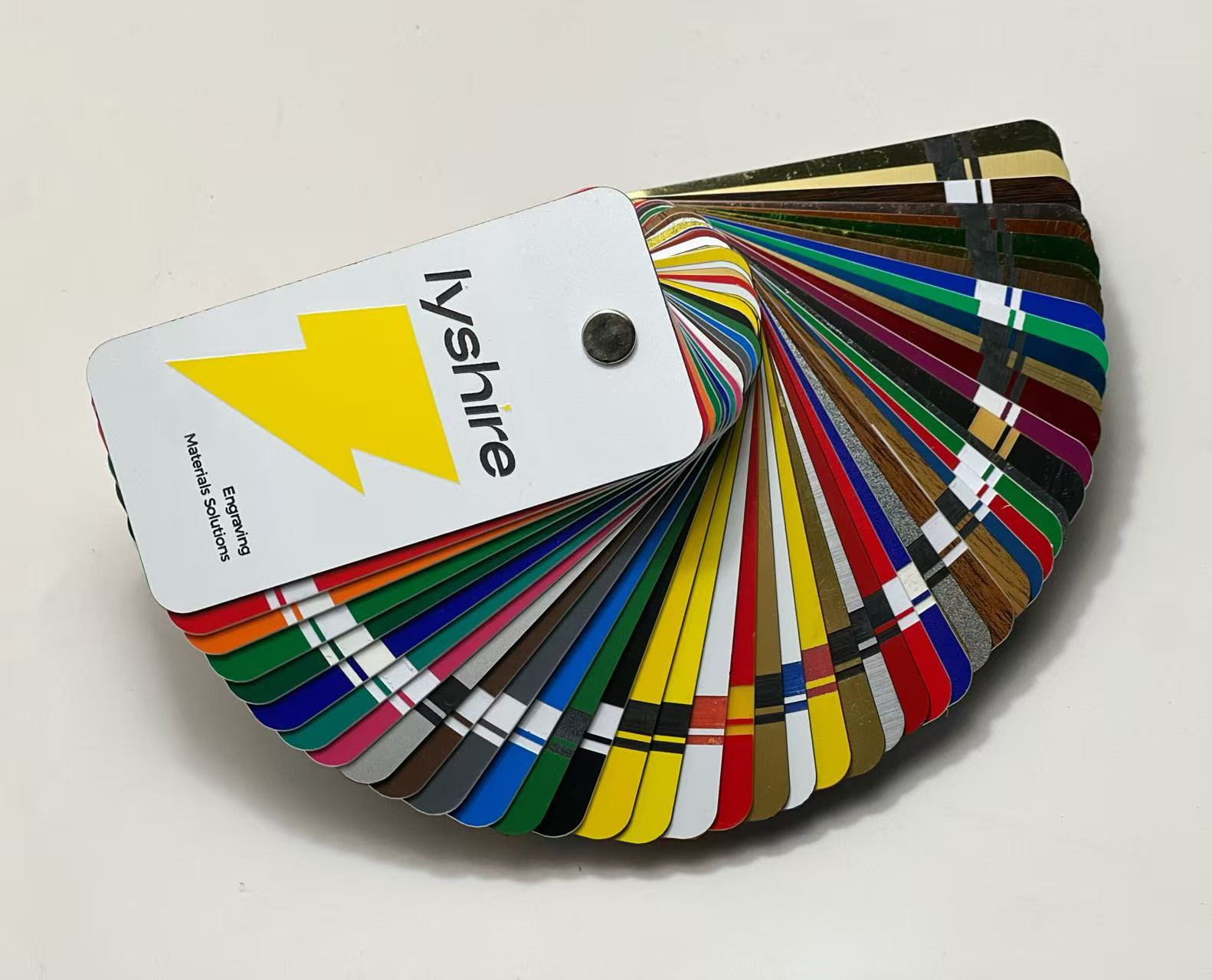
Yes, we stock dozens of pairings like green/white, yellow/black, silver/black, and translucent combos for backlit panels. If your brand needs a specific Pantone match, we can often do custom runs to hit the exact shade for bulk orders.
Vector files (AI, EPS, SVG, or PDF) give us the cleanest path, but we've also turned napkin sketches into polished signs. Our pre-production team will clean up your artwork and suggest adjustments to the engraving depth or line weight so the final product is crisp and readable.
Most projects ship within 7 to 10 business days. If you're on a tight deadline, let us know — we can often rearrange our production queue to accommodate rush jobs without sacrificing quality.
Conclusion
Layering strength into every sign isn’t just a concept—it’s the foundation of our manufacturing process. We build custom 2-ply engraving plastic that combines a tough outer layer with a vividly contrasting core, so precision and durability are literally fused together. Starting from a blank sheet, our engraving technology etches fine details with unwavering accuracy, turning simple panels into bold, high-contrast statements. The result is signage where intricate logos, small text, and complex patterns remain sharp-edged and legible, because they’re carved into the material itself rather than printed on a surface that can wear away. This built-in resilience means the sign resists scratches, UV fading, and the gradual dulling that plagues so many other identification products.
When signage has to handle harsh reality, those crafted cores prove their worth. Our 2-ply plastic withstands outdoor exposure, industrial chemicals, moisture, and constant contact without breaking down or losing visual impact. The inner layer serves as a permanent, high-contrast backdrop; even if the surface gets scuffed over time, the engraved message remains perfectly clear. From exterior wayfinding systems that face years of sun and rain to heavy-use equipment labels in factories, the material resists wear at every level. It’s this combination of a durable core and high-precision engraving that delivers signage solutions where every fine detail is etched to last—turning a functional necessity into a lasting brand asset.
Contact Us
Contact Person: Tina Hou
Email: [email protected]
Tel/WhatsApp: +86 17816238685
Website: https://www.lyshire.com