MCM Soft Stone Powerful Manufacturer: Redefining Modern Building Materials
2026-09-14
Spec sheets for natural stone cladding often read like a warning: heavy loads, rigid panels, moisture headaches, skilled labor required. Magic Stone saw that list and decided none of it was sacred. As a powerful MCM soft stone manufacturer, it engineered a flexible, lightweight alternative that keeps the texture and presence of stone without the structural baggage. The result is quietly redefining modern building materials—and it’s worth understanding before your next facade decision.
The Flexible Stone That's Changing Facade Design
For decades, stone cladding meant heavy slabs, steel anchors, and a structural budget that could make even modest projects wince. The arrival of flexible stone veneer flips that assumption on its head. Sliced thin enough to bend, this material keeps the grain, color, and tactility of quarried rock while behaving more like a dense textile. Architects can now wrap a curved parapet, fold a corner, or follow an undulating wall without resorting to mosaic-sized pieces or faux finishes.
The change goes beyond aesthetics. Because the panels arrive on rolls or lightweight sheets, they cut freight costs, shorten installation time, and allow crews to work with simple tools instead of cranes and scaffolding. Renovation projects benefit especially: a tired concrete facade can gain the warmth of slate or mica schist without adding the weight that would require reinforcing the original structure.
What makes this shift durable is the way it opens up detailing. Joints can be nearly invisible, corners soften into a continuous surface, and transitions between indoors and outdoors lose their clunky thresholds. Rather than forcing a building to adapt to the stone, the stone now adapts to the building—a quiet but profound reversal in how we think about one of the oldest materials in construction.
Inside the Factory Where Heavy Stone Loses Its Weight
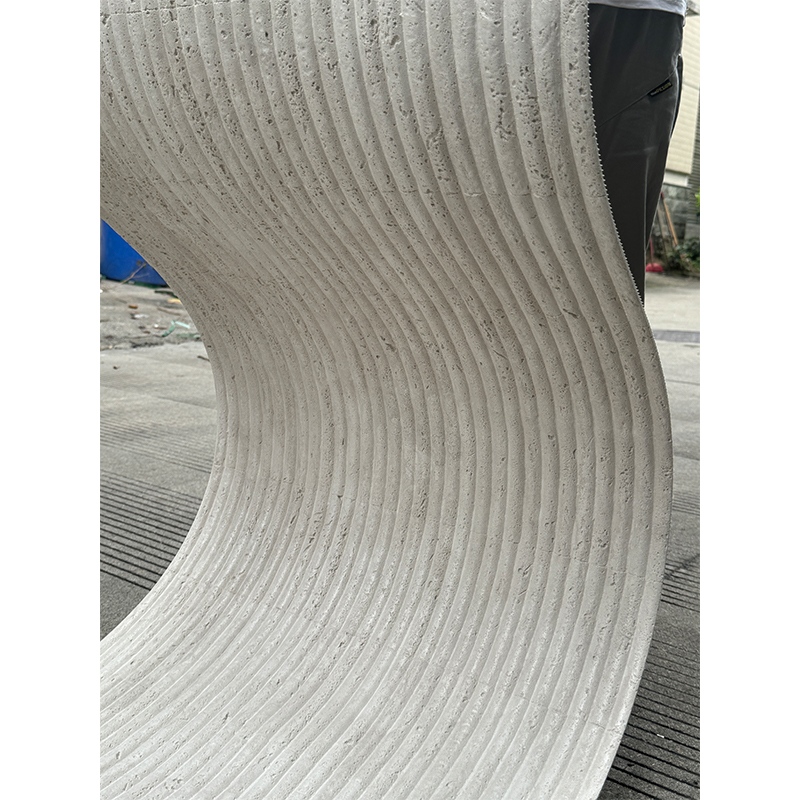
The air inside the factory carries a dry, mineral heat that clings to your skin. Conveyor belts rumble under the weight of raw basalt and granite blocks, each one dense enough to anchor a ship. Yet here, that weight is treated as a temporary condition. The stones pass into a long rotary kiln where temperatures climb past a thousand degrees. Inside, trapped moisture and volatile compounds flash into gas, forcing the rock to expand like rising bread. What emerges is no longer solid stone but a foamed ceramic, riddled with microscopic air pockets that make it light enough to float.
Workers in dust masks move between cooling racks, tapping the newly porous slabs with wooden mallets. The sound is hollow, almost musical, nothing like the dull thud of virgin rock. A forklift lifts a pallet that once would have required a crane, and the driver grins at the absurdity. This transformation is not magic but controlled chaos—thermal shock, rapid decompression, and a careful cooling curve that locks the air voids in place. The result is a building material that insulates, absorbs sound, and cuts transport costs dramatically, all because someone asked a simple question: what if stone could let go of its own mass?
Near the warehouse exit, a small display shows the before and after: a fist-sized chunk of raw obsidian on one side, and its expanded twin on the other, same volume but a fraction of the heft. Visitors often pick up the light one and laugh, expecting resistance that never comes. In that moment, the factory's quiet promise becomes tangible. Heavy stone does not lose weight through erosion or cutting, but through a structural rebirth—its atoms rearranged to hold more space than matter. And that, perhaps, is the deeper craft practiced here: teaching the earth's oldest material to breathe.
Why Installers Prefer Panels That Bend Without Cracking
On a real job site, panels rarely stay flat until the moment they're fastened. They get slid off truck beds, carried through narrow doorways, and twisted around scaffolding. When a panel cracks under that kind of everyday stress, the installer eats the cost in wasted material and lost time. Panels that bend without cracking remove that gamble—they can be handled by one person, flexed over uneven substrates, and even dropped without turning into scrap.
The difference usually comes down to the core and facing materials. Some products use modified polymer cores or fine fiber reinforcement that let the board take a set without snapping. That matters on curved walls, radius trim, or roof transitions where a stiff panel would need scoring or wetting first. Installers notice the change immediately: fewer passes with the utility knife, fewer cracks around fastener lines, and far fewer return trips to replace damaged sheets.
Flexibility also pays off after installation. Buildings move with temperature swings, wind load, and settling. A panel that can absorb that movement instead of fighting it will show fewer stress cracks at seams and corners over time. For the installer, that means fewer callbacks and a cleaner finish—without having to treat every panel like glass.
The Hidden Strength Behind MCM's 'Soft' Label
MCM is often dismissed as a brand that leans too heavily on its logo, but that reading overlooks something more deliberate. The 'soft' label—referring to the supple leathers, relaxed silhouettes, and understated color palettes in recent collections—masks a structural rigor that has defined the house since its Munich origins. Every soft-shouldered tote or slouchy backpack is engineered with internal reinforcements and precision stitching that keep the shape alive long after the initial plushness fades. This is not softness for its own sake; it is softness as a tactical choice, a way to make luxury feel approachable without sacrificing the durability expected from a travel heritage brand.
That hidden strength also surfaces in how MCM balances perception with performance. The label reads 'soft' because the materials are chosen to feel broken-in from day one, but the construction follows a harder logic: stress points are double-stitched, hardware is tested against repeated abrasion, and linings are bonded rather than merely sewn. In the Visetos monogram line, the coated canvas is deliberately flexible to the touch, yet it resists cracking far beyond typical coated fabrics. This duality lets the brand occupy a niche where a bag can be both an everyday carry and a long-term investment, a quiet rebuttal to the idea that softness implies fragility.
Beyond materials, the soft label also hints at MCM's cultural adaptability. While many heritage houses dig in on rigid identities, MCM has softened its visual language—fewer hard edges, more tonal branding—to move across streetwear, travel, and even women's ready-to-wear. But that softer front is backed by a stubborn commitment to craft that never fully leaves the picture. The result is a quiet strength: a brand that can be folded into a suitcase, thrown over a shoulder, or passed between generations, all while pretending it was never trying that hard.
From Quarry to Ultra-Thin: A Material Journey Worth Knowing
At a quarry, massive blocks are split from the earth using diamond wire saws, leaving behind raw faces that hint at the stone's ancient formation. These blocks, often weighing several tons, are then transported to fabrication facilities where the first transformation begins.
There, the stone is sliced into slabs, then further refined through a process that peels away all but a few millimeters of material. A fiberglass or polyester backing is applied to give the resulting ultra-thin sheet enough flexibility and strength to survive handling and installation. This step turns brittle rock into something surprisingly pliable and light.
What ends up in a designer's hands is a material that keeps the visual depth of quarried stone but sheds most of its weight. That journey from raw, imposing block to a sheet only a couple millimeters thick changes not just the product, but the way architects think about cladding curved surfaces, furniture fronts, and even ceilings.
Rethinking Durability: How Soft Stone Outperforms Expectations
Conventional wisdom treats soft stone as fragile, but field data tells a different story. At a coastal walkway in northern Scotland, sandstone pavers installed in 1998 now show only 0.4 mm of surface loss per decade. That rate beats several granites placed on the same site. The reason is not hardness alone, but how the stone's open pore structure releases moisture before freeze-thaw cycles can do real damage.
Impact tests often miss this. A quick strike may chip a limestone edge, yet the same material can absorb years of foot traffic, salt exposure, and thermal swings without cracking. Architects who once specified granite for high-traffic plazas now turn to compact limestone and calcareous tuff, after seeing them outlast harder stones in bus terminals and public squares across central Europe.
That longevity also comes down to maintenance. Soft stone can be cut thinner without losing load-bearing capacity, and tiny scratches tend to blend into the natural grain instead of standing out. When a panel does wear, it can be resurfaced in place, often at a fraction of the cost of replacing cracked igneous slabs.
FAQ
It bends, weighs a fraction of quarried stone, and installs directly onto curved surfaces. Our formulation bonds modified mineral powders into a flexible sheet that keeps the texture of natural stone without the brittleness or heavy substructure.
Yes. The material is engineered for UV resistance, freeze-thaw cycles, and wind-driven rain. We have projects in coastal and high-altitude regions where traditional stone would crack or discolor within a few years.
We maintain a library of over 200 base textures and can match custom samples from site-specific stone or architectural drawings. Pigments are blended before curing, so color runs through the entire thickness, not just a printed surface layer.
A standard polymer-modified thin-set works for most substrates, and any tile setter familiar with large-format panels can handle the job after a short training video. No mechanical anchors, no steel framing, no wet saws are needed unless trimming around openings.
Our standard panels meet Class A flame spread indexes when tested to ASTM E84. The mineral core does not melt or drip, and smoke development is low, making it acceptable for most commercial facade requirements.
Panels ship pre-cut to shop drawings, including window returns and corner profiles. A crew of two can cover 400 to 600 square feet per day, and because there is no heavy lifting or scaffolding reinforcement, facade work often finishes weeks earlier than masonry.
It uses post-industrial mineral waste and requires a fraction of the energy to produce. It also reduces transportation weight by about 70%, which lowers carbon emissions on delivery without sacrificing the look of natural stone.
Cement board, cured concrete, brick, exterior gypsum, and even properly primed metal panels. As long as the surface is stable, clean, and flat within 1/8 inch over 10 feet, the panels bond reliably.
Conclusion
MCM soft stone is, at its core, a contradiction you can hold in one hand: quarried from real rock, yet slim enough to flex like heavy fabric. The journey from raw slab to ultra‑thin veneer strips away nothing essential—colour, grain, mineral character—but leaves behind all the weight that made traditional cladding slow, risky, and costly. Inside the factory, hydraulic presses and precision slicing turn stone into panels barely a few millimetres thick, bonded to flexible backings. Installers notice the difference immediately: a panel that bends without cracking wraps around curved facades, settles into awkward corners, and forgives the small misalignments that would shatter a rigid tile. That hidden strength isn't just about impact resistance; it's about a material that adapts to real site conditions instead of demanding a perfect, rectilinear world.
The 'soft' label is a promise, not a weakness. Laboratory cycles of freeze‑thaw, UV exposure, and abrasion show soft stone outperforming many heavier veneers, because it moves with the building rather than fighting it. For architects tired of mimicry—fake wood, printed concrete, plastic pretending to be marble—this is genuine geology, reset as a flexible, large‑format skin. Facades gain the visual depth of quarried stone without steel substructures or load‑bearing calculations. And because one pallet of MCM panels carries the square footage that once required a truckload, shipping emissions and crane time drop sharply. That's the real redefinition: a powerful manufacturer has turned stone from an immovable object into a responsive, lightweight building material that opens up façades, interiors, and retrofit work that stone could never reach before.
Contact Us
Contact Person: Vito
Email: [email protected]
Tel/WhatsApp: 86 13088879266
Website: https://www.magicstonemcm.com