

ODM Medical Disposable Manifolds: Key Factors for Custom Manufacturing
2026-09-01
Every custom medical manifold starts with a simple question: will it perform flawlessly when patient safety depends on it? For OEMs and device developers, the answer hinges on choices made long before production begins—materials, flow dynamics, sterilization compatibility, and the manufacturing partner’s engineering depth. This is where INT brings a different approach to ODM disposable manifolds, turning complex requirements into reliable, scalable designs. In the sections ahead, we break down the key factors that separate a good manifold from a great one—and why your next project should demand more than a standard off-the-shelf answer.
Balancing Chemical Resistance with Patient Safety
Chemical resistance in medical devices often comes down to material choice, yet that durability can introduce hidden risks. A polymer that withstands aggressive disinfectants might also leach additives over time, or degrade in ways that compromise patient contact surfaces. The real challenge is not just picking a tough material, but understanding how it behaves under repeated exposure to cleaners, bodily fluids, and sterilization cycles while still meeting biocompatibility thresholds.
Clinicians rarely see the trade-offs until a device fails quietly—microcracks from solvent stress, or a surface that becomes tacky after months of wipe-downs. Those changes can harbor pathogens or release particulates. Design teams need to look beyond spec sheets and test under realistic conditions: what happens after a thousand cleaning cycles, or when a new disinfectant enters the hospital formulary? The goal is a material that stays both chemically inert and mechanically stable in the exact environment where it will be used, not just in a lab simulation.
Patient safety hinges on that balance. A device that resists every chemical but causes skin irritation or systemic toxicity is useless. Conversely, a perfectly biocompatible material that swells or cracks after contact with common antiseptics creates infection risks. The most reliable approach is to involve clinicians early, map the full chemical exposure profile for the device's intended lifespan, and choose materials that have been validated as a system—not just as isolated coupons. That kind of integrated thinking keeps both chemical resistance and patient well-being at the center of every decision.
Designing Manifolds That Fit Tight Clinical Spaces
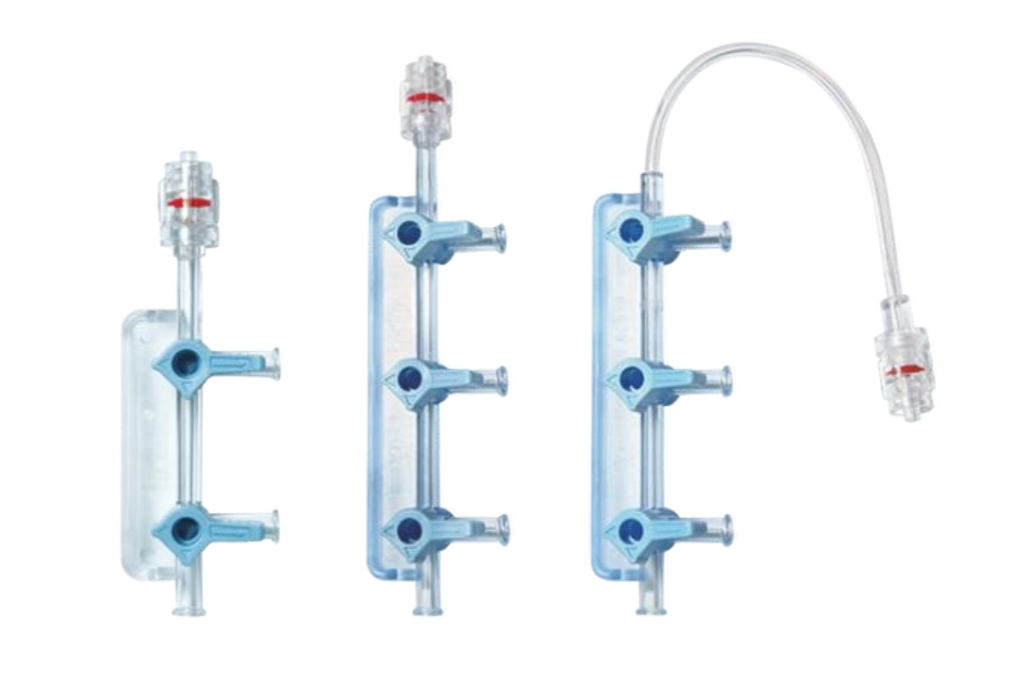
When a manifold has to live inside a handheld surgical tool or a bedside monitor, every cubic millimeter counts. The first step is not shrinking a standard design but questioning the arrangement itself. Instead of a linear stack of ports, a folded or branching topology can nest channels around existing components, using the irregular gaps that a conventional block would waste. This means modeling the manifold in the context of the entire device from day one, treating the available negative space as a design input rather than a constraint discovered later.
Material choice quietly sets the lower bound on wall thickness and minimum feature size. Medical-grade PEEK or ultem can hold a 0.4 mm wall without creep under repeated autoclave cycles, while a rigid polycarbonate may need twice that to survive the same pressure spikes. For tight spaces, additive manufacturing with vapor-smoothed microchannels has moved from prototype curiosity to production reality, allowing a single part to replace what used to be a five-piece bonded stack. The catch is that each layer line becomes a potential leak path, so designers often add a slight helical twist to channels or place them along the Z-height where anisotropy is weakest.
Finally, serviceability cannot be left out of the tight-space equation. A manifold that fits perfectly but cannot be flushed, inspected, or replaced without dismantling the patient-connected circuit will fail in the field. Clever solutions include split-plane designs where the wetted path splits along a single sealing interface, or snap-in flow restrictors that let a clinician clear an occlusion without breaking sterility. By thinking of the manifold as both a fluid router and a removable cartridge, even the tightest clinical envelope can support safe, repeatable use.
Matching Sterilization Cycles to Polymer Behavior
Sterilization choices often fail at the intersection of cycle parameters and polymer behavior, not in the sterilizer itself. Polypropylene and polyethylene, for instance, tolerate steam autoclaving at 121°C for 15–20 minutes, but repeated exposure gradually embrittles them due to oxidative degradation at grain boundaries. The cycle's ramp-up and vacuum pulses can also induce warpage in thin-wall parts because the polymer's glass transition or crystalline relaxation occurs well below the peak temperature.
For heat-sensitive resins like polycarbonate or certain polyurethanes, low-temperature hydrogen peroxide gas plasma or ethylene oxide cycles preserve dimensional stability, but residuals can interact with additives, shifting surface energy and downstream bonding performance. Even radiation-based methods such as gamma or e-beam are not neutral: crosslinking in polyethylene improves wear resistance, while the same dose in fluoropolymers like PTFE triggers chain scission and a measurable drop in molecular weight. Matching the cycle means reading how the material's backbone, crystallinity, and additive package respond to each sterilization stressor—not just checking a compatibility chart.
Cutting Through Regulatory Paperwork Without Delays
Every regulatory submission comes with its own pile of forms, checklists, and fine print. The trick isn't working harder through the stack—it's knowing which documents actually move the needle and which ones just create the illusion of progress. We map out the shortest path that keeps you fully compliant, so you never lose a week to a form that could have been handled in an afternoon.
Most delays come from small mismatches: an outdated template, a missing signature block, a reference number that doesn't line up. Our team treats paperwork like a live system, not a static chore. We check each piece against the latest agency expectations before you submit, so the review desk has no reason to bounce it back for corrections.
You stay focused on the actual work—testing, production, patient enrollment—while we keep the paper trail moving. No waiting on hold to ask what went wrong. No surprise requests three weeks later. Just a clean, forward-moving file that clears the desk without drama.
Handling Volume Spikes Without Sacrificing Tolerance
When a process suddenly sees a surge in output, the instinct is often to tighten every knob and chase consistency. That approach usually backfires. Instead, treat the spike as a stress test for your current tolerances, not a reason to rewrite them. Look at where variation actually appears under the new load. Sometimes a spike exposes a weak point in fixturing or material handling, not in the tolerance itself. Fix those upstream issues first, and the spike becomes just another shift rather than a crisis.
Another trick is to segment the spike. Break the high-volume window into short runs with quick measurement checks in between. This lets you catch drift early without slowing the whole line. Use the data to nudge offsets or tool wear compensation in small increments. You keep the tolerance band intact, but you adjust the process variables around it. It feels slower at first, but after two or three spikes you'll have a playbook that keeps scrap low and throughput high.
Finally, don't let the spike dictate your acceptable quality level. If you loosen tolerance to survive a spike, you'll pay for it later in returns or rework. Instead, use tool condition monitoring and real-time SPC to hold the line. The goal is to absorb the volume without changing the definition of a good part. When the spike ends, you should be able to look at the data and see the same process capability you had before the rush.
Detecting Micro-Leaks Before They Reach the Field
Traditional leak checks often wait until a product is fully assembled and pressurized, but that misses tiny flaws that only reveal themselves under thermal cycling or vibration. Detecting micro-leaks before field deployment means shifting failure discovery left, into the design verification and manufacturing stages. This calls for methods sensitive enough to catch loss rates below 0.5 sccm, not just gross bubbles.
One effective approach pairs pressure decay with helium accumulation in a sealed chamber. The pressure decay curve flags unexpected volume changes, while helium sniffing pinpoints the exact joint or seal. For elastomeric seals, a short vacuum dwell before helium backfill can expose permeation paths that wouldn't show up in a simple dunk test. The trick is calibrating the chamber to ignore ambient helium drift.
Another route uses ultrasonic acoustics during a low-pressure air test. Micro-leaks create a broadband hiss that standard microphones miss, but a narrowband transducer around 40 kHz can isolate the turbulent flow from background noise. This has proven especially useful for battery enclosures and fuel system components, where a single micro-leak can lead to moisture ingress or evaporative emissions months later.
FAQ
Polycarbonate, PVC, and polypropylene are frequently used, but the best choice depends on the fluid path, sterilization method, and whether the manifold needs to resist cracking under pressure or repeated clamping.
We focus on joint geometry and ultrasonic welding parameters early in the design phase. If the bond line is too thin or the energy director is poorly placed, leaks show up only after thousands of cycles, so prototyping with production-intent tooling is essential.
Silicone holds its compression set better after autoclaving and long storage, but it costs more and can leach low levels of siloxanes. TPE is often fine for short-term use, but for reusable manifolds or aggressive chemicals, silicone is safer.
It forces you to lock down connector dimensions early. Changing from a standard Luer to a non-standard port later can invalidate your biocompatibility and performance testing, so the ODM should freeze the interface design before tooling starts.
Yes, by consolidating check valves, filters, and stopcocks into a single molded body or using living hinges instead of separate caps. The trade-off is that complex molds cost more upfront, but piece price and assembly labor drop significantly.
You need a finish below Ra 0.8 µm on wetted surfaces to minimize platelet adhesion and hemolysis. For non-blood paths, a slightly textured finish can improve grip or bonding, but any roughness on sealing surfaces invites bacterial growth and cleaning difficulties.
Use dose audit and bioburden testing rather than overdosing to 50 kGy by default. Also select materials that tolerate 25–40 kGy without significant yellowing or tensile loss. Shared validation from the ODM can cut time if your device uses the same resin and wall thickness.
Conclusion
In custom ODM manifolds, material selection is rarely a simple chemical compatibility exercise; it constantly weighs solvent resistance against cytotoxicity and extractables that could harm patients. Designers often iterate for weeks on polycarbonate or PVC blends that survive aggressive cleaning agents while remaining USP Class VI compliant. Space constraints add another layer: a manifold that works on a bench may fail once crammed into a compact anesthesia workstation or bedside monitor. Angled ports, low-profile luer locks, and custom routing channels become essential, often demanding micro-molding and unusually tight draft angles. Meanwhile, polymer behavior under repeated autoclave, EtO, or gamma exposure dictates whether dimensions shift or micro-cracks appear after the third cycle. A resin that passes initial testing may warp after forty sterilization cycles, so cycle-specific validation is non-negotiable.
Regulatory submission timelines often eat into production schedules unless design history files and material traceability are maintained from day one. A delayed 510(k) or MDR technical file can stall an entire hospital rollout, so forward-thinking ODMs build a regulatory dossier alongside the first prototype instead of retrofitting paperwork later. When order volumes jump from 5,000 to 50,000 units per month, tooling and process capability must absorb that spike without drift in bore diameter or sealing surface flatness. Automated vision inspection and in-line pressure decay testing catch micro-leaks that visual checks miss, preventing a faulty manifold from reaching a critical care unit. Real-time SPC data feeds back into molding parameters, so tolerance bands stay tight even on a third-shift run. The result is a disposables program that doesn't just meet the spec sheet, but survives the messy realities of clinical use and supply chain pressure.
Contact Us
Contact Person: Jeffrey
Email: [email protected]
Tel/WhatsApp: 86-0633-2230056
Website: https://www.sd-intmedical.com